
Continuing Education for Oregon Psilocybin Facilitators: What the Rule Requires and Which Courses Fit
Since January 2026, Oregon psilocybin facilitators need four CE hours to renew. What the rule counts, how to document it, and where PAE's courses fit.
By Peter Addy, PhD, LPC, LMHC | Psychedelic Affirming Education
Write your awesome label here.
The short version: Oregon psilocybin facilitators need four hours of continuing education in each annual license period to renew. Hours from an NBCC-approved provider can qualify, but only if the content is relevant to the facilitator core curriculum. The facilitator writes that relevance description, and OHA, not the provider, decides whether the hours count.
For the first few years of Oregon's program, facilitators renewed their licenses without any continuing education. That changed on January 1, 2026, when Oregon psilocybin facilitator continuing education became a condition of renewal. Every renewal now needs four hours, and the facilitator has to say why those hours count.
This page explains what Oregon's continuing education rule for psilocybin facilitators asks of you, how to document hours from a provider like Psychedelic Affirming Education, and which of our courses I think are relevant to the facilitator curriculum. It also covers what does not transfer from a ketamine course to psilocybin work. I would rather you know where the fit is weaker before you buy than find out when you write your relevance description.
This page explains what Oregon's continuing education rule for psilocybin facilitators asks of you, how to document hours from a provider like Psychedelic Affirming Education, and which of our courses I think are relevant to the facilitator curriculum. It also covers what does not transfer from a ketamine course to psilocybin work. I would rather you know where the fit is weaker before you buy than find out when you write your relevance description.
What the rule requires
The requirement is OAR 333-333-3300, Continuing Facilitator Education. For renewal applications received on or after January 1, 2026, a licensed facilitator must have completed four hours of continuing facilitator education during the annual license period. Hours from an earlier period do not carry forward.
Two conditions decide whether an hour counts.
The content has to be relevant to the core curriculum. The rule ties continuing education to the curriculum that approved training programs teach, set out in OAR 333-333-3050 and OAR 333-333-3060. That curriculum is described below.
The source has to be one of two kinds. Oregon Health Authority (OHA) will consider hours valid when they were offered by:
The second route is the one that matters here. Psychedelic Affirming Education is an NBCC-approved continuing education provider (ACEP No. 7579), approved to offer CE to counselors. That means our courses fall under the second route. No PAE course is approved by OHA, and OHA has not reviewed any of them for facilitator renewal.
For hours from that second route, the rule asks you to document four things:
OHA publishes a Continuing Facilitator Education Hours Log for recording hours. The rule also lets facilitators who teach qualifying education count those hours toward their own four.
The structure is worth noticing. The credential belongs to the provider. The relevance claim is made twice, and neither of us has the last word. OHA's guide, How to Find Approved Continuing Education for Psilocybin Facilitators, says a provider that is not an OPS training program must issue certificates showing the date of training, the provider's name and contact information, the approving organization, and a "relevance statement to core curriculum (OAR 333-333-3050/3060)." Certificates missing any of these, it says, "will not be accepted." So each of our four courses offers two certificates, and the Certificate of Completion for Oregon Psilocybin Facilitators carries all four items, including a relevance statement written for that course. Your log entry still needs your own description of relevance, and only OHA decides whether it holds. Any provider who tells you their course "meets" the requirement is making a claim the rule does not let them make. That includes us, which is why this page says "in my view" rather than "meets."
Two conditions decide whether an hour counts.
The content has to be relevant to the core curriculum. The rule ties continuing education to the curriculum that approved training programs teach, set out in OAR 333-333-3050 and OAR 333-333-3060. That curriculum is described below.
The source has to be one of two kinds. Oregon Health Authority (OHA) will consider hours valid when they were offered by:
- a training program whose curriculum OHA has approved, or
- an organization or conference approved to offer continuing education for other types of professional licenses or certifications.
The second route is the one that matters here. Psychedelic Affirming Education is an NBCC-approved continuing education provider (ACEP No. 7579), approved to offer CE to counselors. That means our courses fall under the second route. No PAE course is approved by OHA, and OHA has not reviewed any of them for facilitator renewal.
For hours from that second route, the rule asks you to document four things:
- the date of the education;
- the name and contact information of the organization that offered it;
- the name of the organization that approved it for other licenses (for our courses, NBCC); and
- a description of how the education is relevant to the core curriculum.
OHA publishes a Continuing Facilitator Education Hours Log for recording hours. The rule also lets facilitators who teach qualifying education count those hours toward their own four.
The structure is worth noticing. The credential belongs to the provider. The relevance claim is made twice, and neither of us has the last word. OHA's guide, How to Find Approved Continuing Education for Psilocybin Facilitators, says a provider that is not an OPS training program must issue certificates showing the date of training, the provider's name and contact information, the approving organization, and a "relevance statement to core curriculum (OAR 333-333-3050/3060)." Certificates missing any of these, it says, "will not be accepted." So each of our four courses offers two certificates, and the Certificate of Completion for Oregon Psilocybin Facilitators carries all four items, including a relevance statement written for that course. Your log entry still needs your own description of relevance, and only OHA decides whether it holds. Any provider who tells you their course "meets" the requirement is making a claim the rule does not let them make. That includes us, which is why this page says "in my view" rather than "meets."
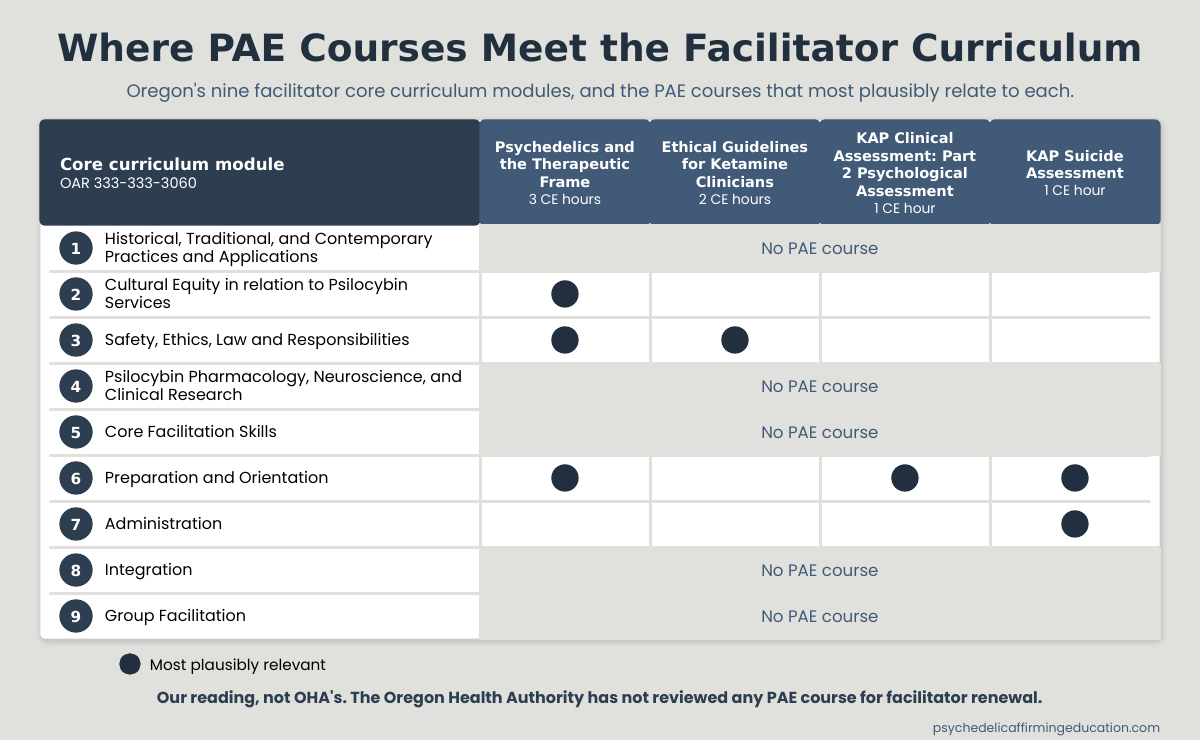
The core curriculum, module by module
Rule 3050 sets the minimum training hours for each of nine modules, and rule 3060 lists what each one covers. These are the categories your relevance description should point to.
How to write a relevance description
The rule asks for a description, not an essay. In my reading, a good one does three things in two or three sentences:
The third part is where descriptions go wrong. Several of the courses below were written for licensed clinicians, and they teach clinical tasks: structured assessment, diagnosis-adjacent judgment, clinical documentation. By default, a facilitator does not perform those tasks while providing psilocybin services. OAR 333-333-5130 bars a facilitator from any conduct that requires additional professional licensure, "including but not limited to diagnosing and treating physical or mental health conditions," and a facilitator who holds another license may not exercise its privileges during sessions. The curriculum is explicit about scope too: module (3) covers "facilitator scope of practice and expectation of referral when scope of practice is exceeded," and module (6) covers "the limits of facilitator's scope of practice." Scope is the line that separates a licensed facilitator from the unregulated psychedelic coach, and it is worth taking seriously here. So describe what transfers to the facilitator's role (recognizing a concern, knowing when to refer, holding a boundary) rather than the clinical skill itself.
There is one exception, and it matters for dual-licensed readers. Since January 2026, a facilitator who also holds a license from one of seven named Oregon boards (including the counselor, psychology, and social work boards) and has notified OHA may provide health care or behavioral health care during preparation and integration sessions, as long as they tell the client first. Never during administration. I wrote about this change, and the continuing education rule that arrived with it, when both took effect in January. If that is you, the clinical skills in these courses can apply directly in preparation and integration, and your description can say so.
A workable example:
This course is relevant to Module (6), Preparation and Orientation, specifically "identification of client safety concerns." It covered how psychological history bears on readiness for a non-ordinary state. I will use it to recognize when a client's history calls for referral before an administration session.
Adapt it. If you copy a description word for word from a provider's page, you have to own up to those claims.
- Names the module, by its number and title in rule 3060.
- Names the sub-item the course content touches, in the rule's own words where you can.
- Says what you will use in facilitation, within a facilitator's scope.
The third part is where descriptions go wrong. Several of the courses below were written for licensed clinicians, and they teach clinical tasks: structured assessment, diagnosis-adjacent judgment, clinical documentation. By default, a facilitator does not perform those tasks while providing psilocybin services. OAR 333-333-5130 bars a facilitator from any conduct that requires additional professional licensure, "including but not limited to diagnosing and treating physical or mental health conditions," and a facilitator who holds another license may not exercise its privileges during sessions. The curriculum is explicit about scope too: module (3) covers "facilitator scope of practice and expectation of referral when scope of practice is exceeded," and module (6) covers "the limits of facilitator's scope of practice." Scope is the line that separates a licensed facilitator from the unregulated psychedelic coach, and it is worth taking seriously here. So describe what transfers to the facilitator's role (recognizing a concern, knowing when to refer, holding a boundary) rather than the clinical skill itself.
There is one exception, and it matters for dual-licensed readers. Since January 2026, a facilitator who also holds a license from one of seven named Oregon boards (including the counselor, psychology, and social work boards) and has notified OHA may provide health care or behavioral health care during preparation and integration sessions, as long as they tell the client first. Never during administration. I wrote about this change, and the continuing education rule that arrived with it, when both took effect in January. If that is you, the clinical skills in these courses can apply directly in preparation and integration, and your description can say so.
A workable example:
This course is relevant to Module (6), Preparation and Orientation, specifically "identification of client safety concerns." It covered how psychological history bears on readiness for a non-ordinary state. I will use it to recognize when a client's history calls for referral before an administration session.
Adapt it. If you copy a description word for word from a provider's page, you have to own up to those claims.
Where our courses fit
I think that four PAE courses, 7 CE hours in total, are relevant to the facilitator curriculum. Three are about ketamine; one is not. All four were built for licensed mental health professionals, so a facilitator without clinical training will find parts of them pitched at clinicians. Facilitators have taken them anyway, and some have told us the material applied.
Psychedelics and the Therapeutic Frame (3 CE hours)
Psychedelics and the Therapeutic Frame is the one course here that is not about ketamine. It covers the pharmacology of the three mechanism families (classic psychedelics such as psilocybin, empathogens, and dissociatives), contraindications and drug interactions, federal and Oregon legal status, the line between a licensed clinician's role and a facilitator's, the Psychedelic Harm Reduction and Integration framework, first-contact responses when a client discloses psychedelic use, and the field's recent ethical failures. It also centers equity: who benefits from the psychedelic renaissance, Oregon's access data, and Indigenous lineages. Those access questions have only sharpened as Oregon's service centers have closed.
Modules: (2) Cultural Equity in relation to Psilocybin Services, for racial justice and "the impact of race and privilege on health outcomes," "the impact of drug policy on individuals and communities," and systemic inequity in the delivery of care; (3) Safety, Ethics, Law and Responsibilities, for laws and regulations, "facilitator scope of practice and expectation of referral when scope of practice is exceeded," the "historical and contemporary abuse of power associated with psychedelics," and harm reduction; and (6) Preparation and Orientation, for identifying client safety concerns, including contraindicated medication, and "facilitator role and the limits of facilitator's scope of practice."
Draft description: Relevant to Module (3), Safety, Ethics, Law and Responsibilities; Module (2), Cultural Equity; and Module (6), Preparation and Orientation. The course covered contraindications and medication interactions, harm reduction, abuse of power in psychedelic settings, racial and class disparities in access to legal psychedelic services, and the boundary between a facilitator's role and a licensed clinician's. I will use it to screen for contraindicated medications at intake, to keep my work within facilitator scope, and to recognize when a client needs referral.
What does not transfer: two things. It is written from the clinician's side of the scope boundary, about responding to clients who use psychedelics, not about facilitating a session. And its pharmacology is a survey across substances, so I do not count it toward module (4), which asks for psilocybin's pharmacokinetics, its metabolism, and the potency of available psilocybin products.
Ethical Guidelines for Ketamine Clinicians (2 CE hours)
Ethical Guidelines for Ketamine Clinicians covers the ethical problems that non-ordinary states introduce: boundaries before, during, and after a session, trauma-informed ethics, client autonomy, and ongoing accountability.
Module: (3) Safety, Ethics, Law and Responsibilities, for "awareness of increased vulnerability associated with altered states of consciousness," emotional and sexual boundaries "both during provision of psilocybin services and at other times," and resources for professional development.
Draft description: Relevant to Module (3), Safety, Ethics, Law and Responsibilities. The course addressed client vulnerability in non-ordinary states and maintaining boundaries before, during, and after a session. I will apply it to boundaries and consent in my facilitation.
What does not transfer: the setting. Ketamine-assisted psychotherapy happens inside a medical and clinical frame, with a prescriber and a licensed therapist. Oregon's psilocybin services sit outside that frame: the required informed consent has every client acknowledge that the services "are not a medical or clinical treatment" (OAR 333-333-5040). Some of the course's examples will need translating to a facilitator's relationship with a client.
KAP Clinical Assessment: Part 2 Psychological Assessment (1 CE hour)
KAP Clinical Assessment: Part 2 covers assessing psychological readiness; sorting contraindications into those that exclude, those that need more evaluation, and those that need support; evaluating expectations; and informed consent.
Module: (6) Preparation and Orientation, for informed consent, the client's reasons for seeking services, identification of safety concerns including psychological instability, and "determination of whether a client should participate in an administration session."
Draft description: Relevant to Module (6), Preparation and Orientation. The course covered readiness, expectations, and informed consent before a non-ordinary-state session. I will use it to identify psychological safety concerns at intake and to decide when a client should be referred rather than proceed.
What does not transfer: the assessment itself. The course teaches a licensed clinician's psychological assessment. A facilitator works from the client information form and refers out when the form raises a concern, which module (6) names directly. Write your description around recognition and referral, not assessment, unless you are a dual-licensed facilitator using the exception described above.
KAP Suicide Assessment (1 CE hour)
KAP Suicide Assessment covers risk and protective factors, focused interviewing about suicidal ideation and behavior, documentation, and responses to suicide risk in a ketamine context.
Modules: (7) Administration, which lists suicidality among the "challenging behaviors during an administration session"; and (6) Preparation and Orientation, for "client directed safety planning."
Draft description: Relevant to Module (7), Administration, which names suicidality as a challenging behavior during a session, and to safety planning in Module (6). The course covered risk and protective factors for suicide in the context of a non-ordinary-state treatment. I will use it to recognize risk and to know when a client needs a higher level of care.
What does not transfer: structured suicide risk interviewing and clinical documentation are licensed-clinician work. For a facilitator, the relevant skill is recognizing risk, supporting the client's own safety plan, and referring, which module (5) describes as knowing "when a client may need a higher level of care." A dual-licensed facilitator who has notified OHA can use more of the course during preparation and integration sessions.
Further Reading
For the regulatory background, start with what changed for facilitators in January 2026 and Oregon's new potency rules. For the state of the program itself, read what the service-center closures and outcome data show and what the state collects from clients and reports about them. For the curriculum's science and scope modules, see how psilocybin acts on the brain and where coaching ends and therapy begins.
Frequently asked questions
Do CE hours from an NBCC-approved provider count toward Oregon facilitator renewal?
They can. OAR 333-333-3300 accepts hours from organizations approved to offer continuing education for other professional licenses, which includes NBCC-approved providers. The hours must also be relevant to the facilitator core curriculum in OAR 333-333-3050 and 3060, and you document that relevance yourself. OHA, not the provider, decides whether the hours are valid.
Is any Psychedelic Affirming Education course approved by OHA?
No. PAE is an NBCC-approved continuing education provider (ACEP No. 7579), and our courses qualify, if at all, through the rule's second route: an organization approved to offer CE for other licenses. OHA has not reviewed any PAE course for facilitator renewal. When you log the hours, you name NBCC as the approving organization.
Who decides whether a course is relevant to the core curriculum?
You make the case and OHA decides. The rule requires your documentation to describe how the education is relevant to the core curriculum. OHA's guide also asks providers to put a relevance statement on the certificate, so each PAE course offers a facilitator certificate that carries one. Neither statement settles the question, which is why no provider can promise that its course will count.
Can a course about ketamine count toward a psilocybin facilitator license?
It can, if its content is relevant to the curriculum. Relevance runs through the topic, not the substance: the curriculum lists suicidality as a challenging behavior during administration, and boundaries in non-ordinary states as an ethics subject. What does not carry over is pharmacology, because ketamine's mechanism is not psilocybin's and module (4) is psilocybin-specific.
What do I need to document for each course?
For hours from an organization approved for other licenses, OAR 333-333-3300 asks for four things: the date; the name and contact information of the organization that offered the course; the name of the organization that approved it; and your description of how it relates to the core curriculum. OHA's Continuing Facilitator Education Hours Log is built for this.
Do hours from before my current license period count?
The rule counts four hours completed during your annual license period, so hours finished before the period began do not meet its wording. Plan your hours inside the year before your renewal. If your situation is unusual, such as a late renewal or a reinstatement, ask the OPS licensing team directly rather than relying on a provider's answer.
Can I count hours I spend teaching continuing education?
Yes, under the rule's own terms. OAR 333-333-3300 lets facilitators who provide valid continuing facilitator education record and report those training hours toward their own four. The teaching still has to meet the same relevance standard, so the content you teach must relate to the core curriculum, and you should document it the same way.
Can a dual-licensed facilitator use clinical skills during psilocybin sessions?
Only in preparation and integration, and only after two notices. Under OAR 333-333-5130, a facilitator licensed by one of seven named Oregon boards, including counseling, psychology, and social work, must notify OHA and must tell the client before providing health or behavioral health care. Clinical services during administration sessions remain prohibited.
Peter H. Addy, PhD, LPC, LMHC is a Portland-based licensed therapist and the founder of Psychedelic Affirming Education, an NBCC-approved continuing education provider for licensed mental health professionals and Oregon Psilocybin Services facilitators. His research background includes work at Yale School of Medicine on psychedelic substances.
About Peter · Continuing education policies
About Peter · Continuing education policies

Pages
Created with