Psychedelic Harm Reduction and Integration (PHRI): A Clinician's Guide

By Peter H. Addy, PhD, LPC, LMHC
Published June 29, 2026 · Updated June 29, 2026
A client mentions, near the end of a session, that she took mushrooms with a friend over the weekend. Not in a trial. Not at an Oregon service center. In her friend's living room, because she had read that psilocybin might help with the depression that two SSRIs hadn't touched. Then she watches your face to see what happens next.
The short version: Psychedelic Harm Reduction and Integration (PHRI) is an evidence-informed clinical stance for working with clients who use psychedelics, regardless of whether you ever administer a substance. It combines non-judgmental harm reduction with structured integration, meaning the work of making sense of an experience after the fact. PHRI is not a protocol or a credential. It is a way to apply what you already know, within your existing scope.
What happens next is the real question. You did not administer anything, and you are not about to. The legality is clear. Still, she is your client, something happened, and she is asking for help making sense of it. Most graduate programs did not prepare you for this moment. PHRI is the model that does, and it asks less of you than the name implies.

What PHRI actually is

The framework has a specific origin. In 2021, Ingmar Gorman, Elizabeth Nielson, and colleagues published Psychedelic Harm Reduction and Integration: A Transtheoretical Model for Clinical Practice in Frontiers in Psychology, defining PHRI as a transtheoretical, transdiagnostic approach to working with patients who are using or considering using psychedelics in any context, without the clinician providing the substance. It combines harm reduction psychotherapy, the relational stance of psychedelic-assisted therapy, mindfulness-based approaches, and psychodynamic listening.

It is a way to bring competencies you already have to a situation your training did not address. The “transtheoretical” label is doing real work: whether you practice from a CBT, psychodynamic, ACT, or somatic base, PHRI describes a stance you layer on top of it, not a modality you have to adopt instead.

  • Harm reduction is the stance you take toward use that is already happening or being considered: meet it without moralizing, reduce risk where you can, and stay in the room.
  • Integration is the work of helping a client metabolize what will happen or happened into something usable, durable, and connected to the rest of their life.
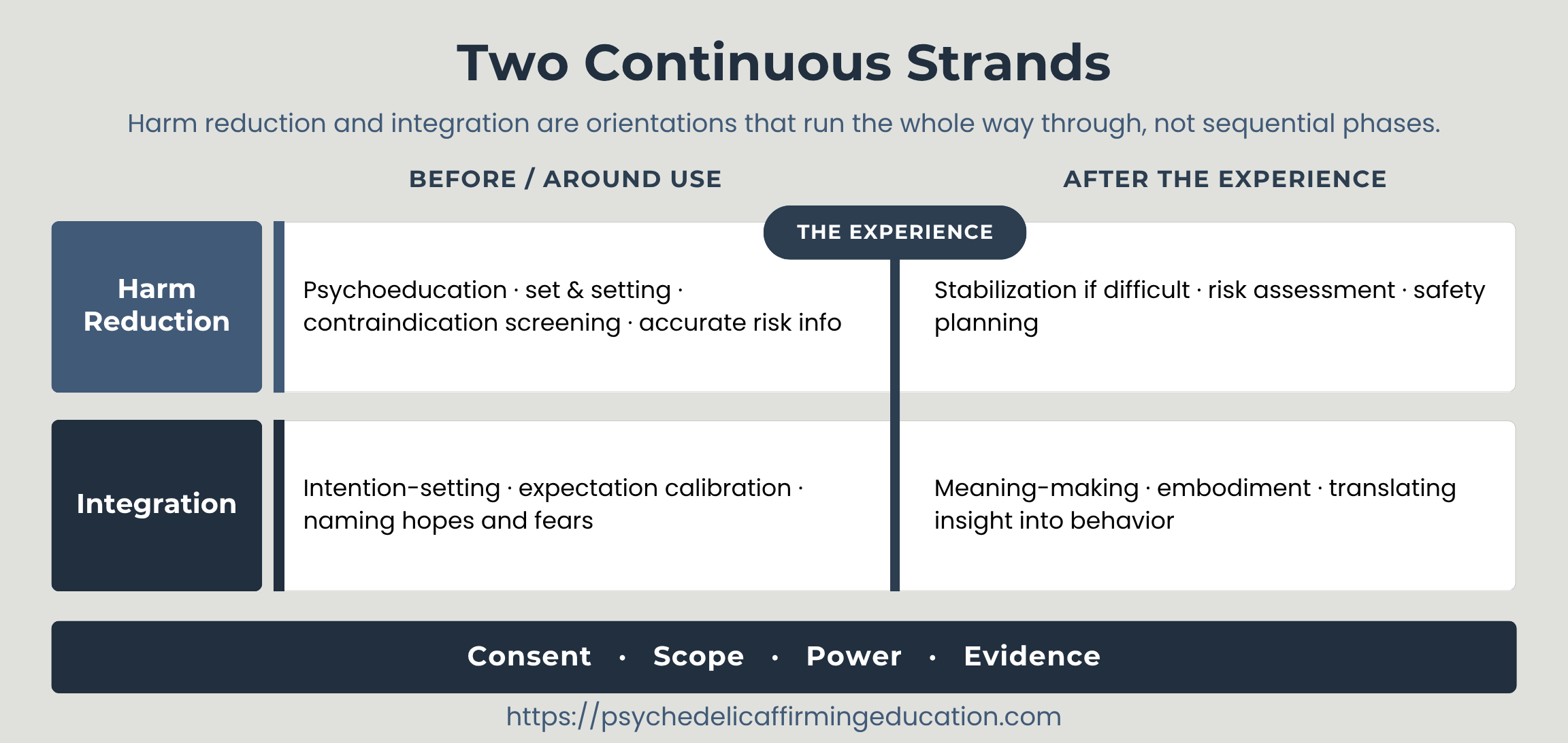
Diagram showing harm reduction and integration as two continuous strands running before/around use and after the experience, rather than sequential phases. Harm reduction row: psychoeducation, set and setting, and contraindication screening before use; stabilization, risk assessment, and safety planning after. Integration row: intention-setting and expectation calibration before use; meaning-making and translating insight into behavior after.

Why you will meet these clients whether or not you seek them

This is not a niche concern. Hallucinogen use among U.S. adults is what the National Institute on Drug Abuse calls historic highs. In 2023, past-year hallucinogen use reached about 9% among adults aged 19 to 30, and 4% among adults 35 to 50. If you see clients, some are using.

The problem is that they are not telling you. The disclosure gap is wide, and it is the single most practical reason every clinician needs a PHRI stance: you cannot reduce harm or support integration for a use you never hear about. A client who has watched you flinch at the word “mushrooms” will simply route around you, and you will lose the clinical thread on something that may matter enormously to their care. The work of becoming someone clients will disclose to is covered in the post on why clients aren't telling you about their psychedelic use, and it starts before the topic ever comes up.

Harm reduction without the moralizing

Harm reduction has a long, evidence-based history outside psychedelics: needle exchange, alcohol and opioid work, sexual health. The premise is unsentimental. People use substances. Abstinence-only responses drive use underground, where it gets more dangerous. A clinician who stays connected can reduce real risk. PHRI takes that premise and applies it here.

In practice, this means a few concrete things. You can talk accurately about set and setting, about differences between substances and their relative risk profiles, about drug interactions that matter, without endorsing or encouraging use. A client who can tell you the dose, the setting, who will be present, and what medications she takes is safer than one who cannot. The clinician who shuts down that conversation has not prevented use. They have only ensured they will not be consulted on the parts that affect safety.

Harm reduction is not approval, and it is not a green light. It coexists with clear-eyed assessment. A personal or family history of psychotic disorders is a serious contraindication for most classic psychedelics. Cardiovascular risk matters. So do current stability, support, and reasons for use. Naming those risks honestly is harm reduction. It is not a retreat from it. The skill is holding both: non-judgmental about the person, precise about the danger.

Integration is the work. It is not an add-on.

If there is one claim this field repeats, it is that integration is where lasting change happens. I believe it, and I have said so in print. I also want to be clear about how solid that claim is. You deserve to know before you build a practice on it.

Here is the honest version. Integration appears in every psychedelic trial, usually three sessions after dosing, but that number is a convention, not a finding. The concept itself was only rigorously defined in 2022, when Bathje and colleagues published the first full concept analysis and documented the extent of disagreement surrounding the term. An international working group has since produced practice guidelines for mental health professionals, and researchers have built validated Psychedelic Integration Scales to measure it. What does not yet exist is outcome research isolating integration as a variable: a 2023 paper put it bluntly, noting that current integration models “each lack any empirical support and thus cannot be described as evidence-based”. I discuss this in the post on the integration research gap.

So the claim that integration drives lasting change rests, for now, on clinical consensus, not controlled outcome data. That does not make it wrong. It makes it a place to practice with humility, to track your own outcomes, and to resist anyone selling a proprietary integration protocol as if the evidence were settled. The practical techniques that consensus does support, the ones worth knowing while the science catches up, are in the posts on integration techniques for therapists and integration best practices.

What PHRI asks of the clinician

Most of this is already inside your scope. Talking with a client about an experience, helping them make meaning of it, assessing risk, supporting safety: that is therapy. You do not need a special license to do PHRI, because PHRI does not involve administering anything. What it asks for is competence, not credentials you do not have.

That competence has a few specific demands:
  • Informed consent is ongoing, a continuous conversation rather than a form, because a client’s relationship to their use will change over time.
  • Scope of practice stays sharp. You can support integration of an experience a client chose to have; you cannot direct, recommend, or facilitate illegal use. You should be able to articulate that line clearly.
  • Power dynamics are real, even in your office. A client who has had an experience that felt sacred or shattering may grant your interpretations more authority than usual. Naming that, rather than enjoying it, is part of the job.


Two posts go deeper here: power dynamics in psychedelic therapy and the ethics of touch and consent.
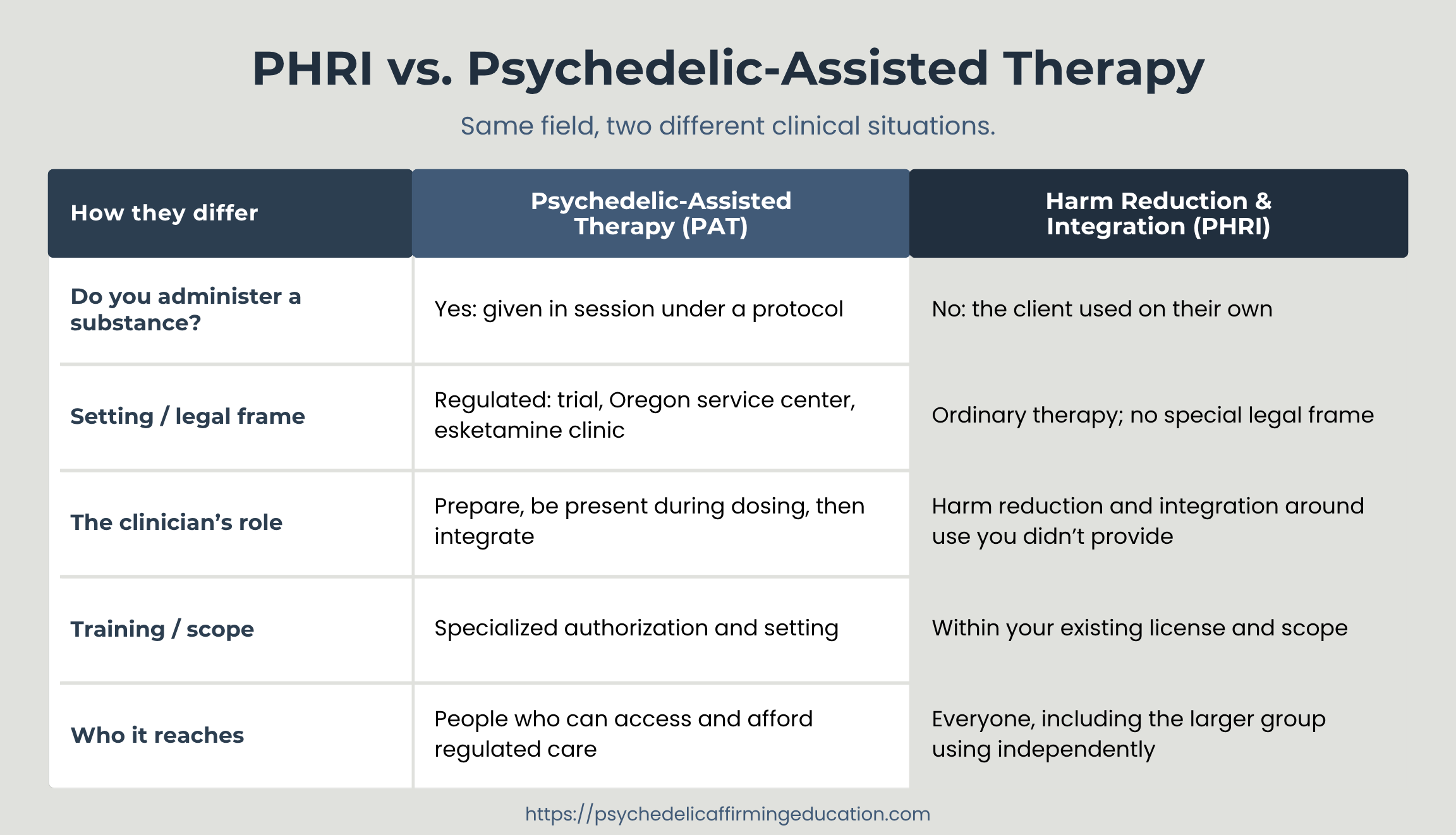
Comparison table contrasting Psychedelic-Assisted Therapy (PAT) with Harm Reduction and Integration (PHRI) across five dimensions. PAT involves administering a substance in a regulated setting (trial, Oregon service center, or esketamine clinic), with the clinician present during dosing and requiring specialized authorization. PHRI involves no substance administration by the clinician — the client uses independently — takes place in ordinary therapy with no special legal frame, falls within existing license and scope, and reaches a broader population, including people using independently outside regulated care.

The shape of the market

At the top sits regulated, paid care: ketamine clinics, Oregon service centers, retreats, training programs, and coaches. These are priced for people who already have money. Below that is everyone else: the much larger group using psychedelics on their own, the way your client did in her friend’s living room. PHRI is the clinical model that reaches this group. That is why it matters.

The population below that line is not random. It is shaped by who can afford to opt into legal care and who cannot. It is shaped by a drug war whose arrests and incarceration continue to fall, as they have for decades, disproportionately on Black and brown communities. These are the same communities now least likely to see themselves reflected in a service center’s clientele.

This is my read, not a clinical finding. A field that monetizes these medicines for the affluent, while those who bear the cost of prohibition remain priced out, is not correcting healthcare inequity. It is rebuilding it with new branding. That is the economic structure, not a personal failure of anyone inside it. Making competent harm reduction and integration care, and the training to provide it, accessible belongs at the center of this work, not in its footnotes.

Where this connects

If you want the structured, CE-bearing version of this material, Psychedelics and the Therapeutic Frame works through the clinical frame in depth. If you want a free, practical starting point for the exact moment a client discloses, the guide on what to do after your client uses psychedelics is built for that.
The posts below go deeper on individual pieces of the model: the disclosure gap and why clients stay silent; integration techniques and best practices; the integration research gap; integration for chronic pain; intention setting and therapeutic surrender in preparation; breathwork preparation; distinguishing spiritual emergence from crisis; and the broader case for integrating psychedelic medicines into mental health care

Frequently asked questions

What is Psychedelic Harm Reduction and Integration (PHRI)?

PHRI is a transtheoretical clinical model, defined by Gorman and colleagues in 2021, for working with clients who use or are considering psychedelics, without the clinician administering anything. It combines harm reduction psychotherapy with integration, the work of making meaning afterward, and applies across diagnoses and therapeutic orientations.

How is PHRI different from psychedelic-assisted therapy?

In psychedelic-assisted therapy, the clinician administers a substance within a legal protocol and supports the client through the experience. PHRI involves no administration. It is the model for the far more common situation where a client uses psychedelics independently and brings that experience into ordinary therapy for harm reduction and integration support.

Do I need special training or a license to practice PHRI?

No special license is required, because PHRI does not involve administering any substance. It draws on competencies licensed clinicians already have. What it asks for is specific competence: understanding harm reduction, integration practices, contraindications, scope-of-practice limits, and the heightened power dynamics involved. Continuing education in these areas is an ethical responsibility, not a legal requirement.

Is supporting a client’s illegal psychedelic use within my scope?

You can support a client in making meaning of an experience they chose to have, and you can reduce harm by discussing risk honestly. You cannot direct, recommend, or facilitate illegal use. The distinction is between responding to what a client brings you and instigating or arranging use, and articulating that line clearly is part of practicing PHRI responsibly.

What does the evidence actually show about integration?

Integration is a near-universal component of psychedelic trials and is supported by strong clinical consensus, but no published study has yet isolated it as a variable. Definitions, practice guidelines, and validated measurement scales now exist, while outcome research does not. The claim that integration drives lasting change is clinically grounded, not yet experimentally proven.

How do I become someone clients will disclose psychedelic use to?

Disclosure follows safety. Clients read your reactions long before they test you with the topic, so a non-judgmental, accurate, non-moralizing stance toward substances signals that the conversation is safe to have. Avoiding visible alarm, knowing the basics, and asking open questions about use all increase the likelihood of disclosure.
Author: Peter H. Addy, PhD, LPC (Oregon), LMHC (Washington), is a licensed psychotherapist, clinical supervisor, and former Yale School of Medicine postdoctoral researcher in psychedelic science. He is the founder of Psychedelic Affirming Education, an NBCC-approved continuing education provider (ACEP No. 7579). PAE’s accuracy and editorial standards: https://psychedelicaffirmingeducation.com/ce-policies

Created with