Your client used a psychedelic. The next session is where the clinical work begins.

Most psychedelic training focuses on the medicine session. In my experience, that is not where the lasting clinical work takes place. The sessions that follow are where integration and meaning-making happen.

Your client used a psychedelic, whether legally or not, with a facilitator or on their own. Now they are in your office describing what happened: sometimes an insight, sometimes disorientation, sometimes real distress. Integration is the process of helping them make sense of it, within your clinical scope and with attention to safety. This work draws on skills you already use.

This page is a starting point: a free, practical workbook for clinicians who find themselves in this situation and want to respond with clinical competence rather than improvisation.

A Practical Guide for Real Clinical Situations

Download the free workbook
We use your email to send the guide and occasional updates for clinicians. Unsubscribe anytime.

What to Do After Your Client Uses Psychedelics
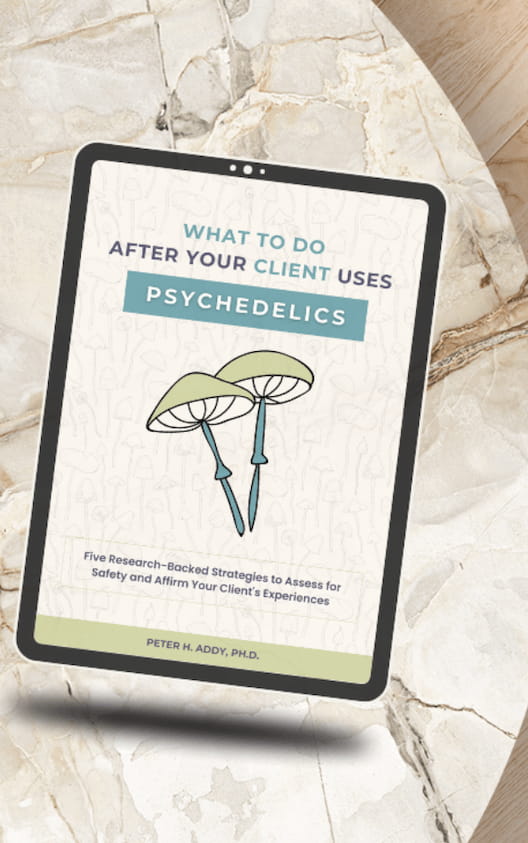
Tablet displaying the cover of 'What to Do After Your Client Uses Psychedelics' by Dr. Peter H. Addy
Five research-informed strategies you can apply in your next session:
  • Assess safety and recognize when something needs closer attention
  • Support emotional regulation after a difficult or intense experience
  • Help clients explore meaning without overwhelming them
  • Integrate insights into ongoing therapy in a clinically grounded approach
  • Know when consultation or referral is the right call
This resource is for licensed professionals who want to support clients within their existing practice, not to become psychedelic specialists. It is grounded in evidence and clear about scope and limitations.

Built for Clinicians Who Don’t Want to Specialize

Looking for a more comprehensive framework?

Integration is one part of Psychedelic Harm Reduction and Integration (PHRI), the evidence-based model that informs this workbook. The full guide outlines the entire approach, from screening through integration.

If you are seeking a structured version with CE credit

The workbook outlines the key interventions. The course provides a more detailed exploration. Psychedelics and the Therapeutic Frame (3 CE hours) addresses how to maintain the clinical frame when a client brings psychedelics into therapy. This is continuing education from an NBCC-approved provider (ACEP No. 7579). It is intended to build a knowledge base. It does not replace supervised practice, and I will not claim that it does.

Dr. Peter H. Addy, PhD, LPC, LMHC

Peter H. Addy is a licensed psychotherapist in Oregon and Washington and the founder of Psychedelic Affirming Education. He has studied psychedelics and non-ordinary states of consciousness academically for 18 years, including postdoctoral research in psychedelic science at Yale School of Medicine, and practices ketamine-assisted psychotherapy in Portland. He built PAE's continuing education catalog to make competent training accessible to clinicians.

Download the Free Guide

Get immediate access to “What to Do After Your Client Uses Psychedelics.”

Start building clarity, confidence, and ethical grounding. One conversation at a time.

We use your email to send the guide and occasional updates for clinicians. Unsubscribe anytime.
Created with