The session is scheduled. It might be psilocybin at a licensed Oregon center, ketamine-assisted psychotherapy, or another legal option. The logistics are handled. Now comes the interval before the session, which is often when questions about preparation become most pressing.
This page shows what preparation can realistically address in that interval, and what it cannot.
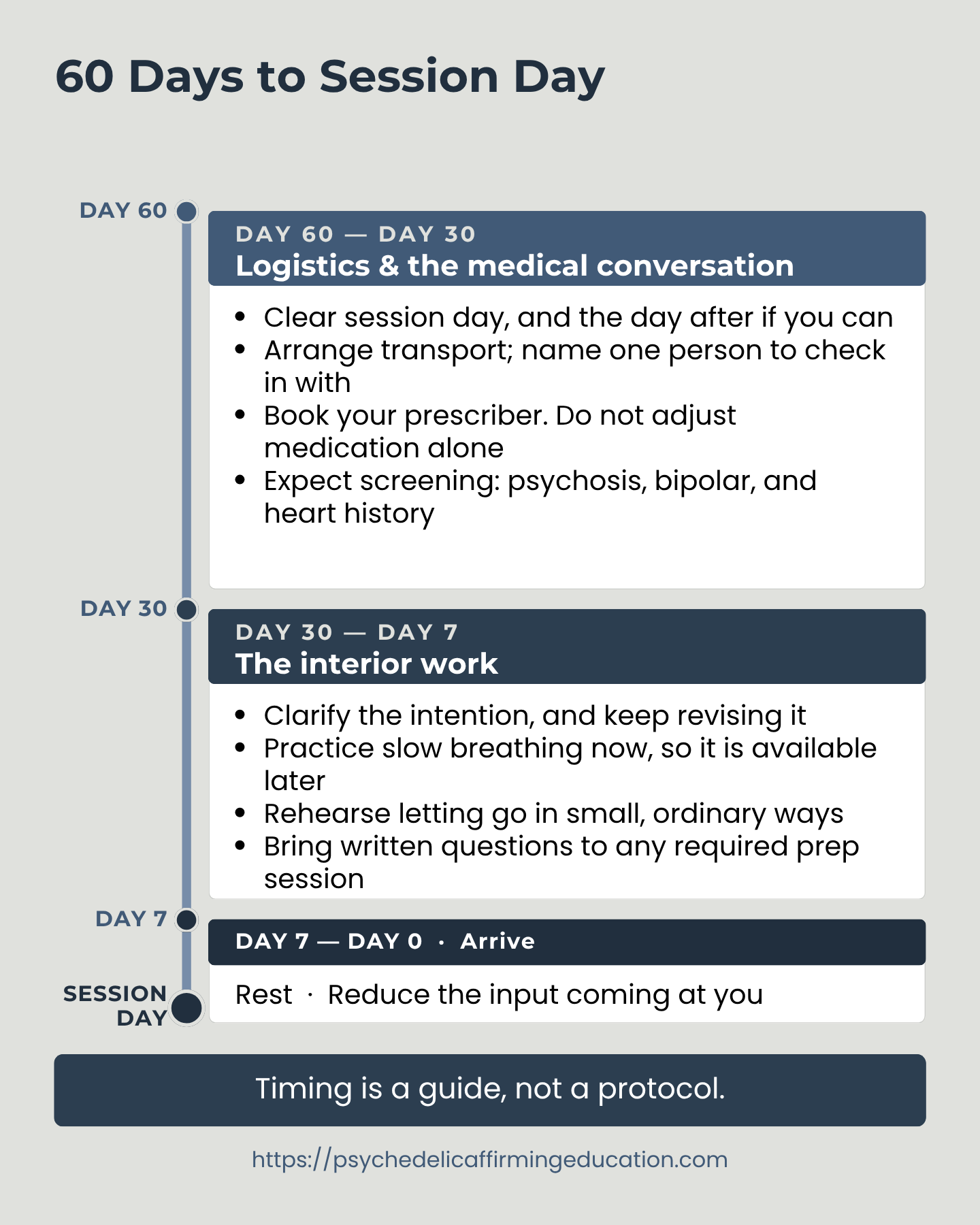
Preparation includes both practical and interior work. The practical side covers logistics, medical screening, and a direct conversation with your prescriber about current medications. The interior side involves clarifying your reasons for pursuing the experience, building some tolerance for fear, and examining your relationship to control. Most discourse in this field centers on the medicine. Preparation is everything else.
Preparation supports careful screening and a competent guide; it does not substitute for either. No amount of reading makes it safe to skip screening or to work with someone unqualified. The
largest survey of difficult psilocybin experiences, which gathered accounts from nearly two thousand people, found that those who ended up putting themselves or someone else at risk of physical harm tended to have taken higher doses, endured longer experiences, and lacked both physical comfort and people to support them; the same researchers emphasized that serious harm is rare when participants are screened, prepared, and supported.
The relationship with whoever guides you is not a formality either: in a
trial of psilocybin for depression, the strength of the bond between patient and therapist predicted both the quality of the experience and the clinical outcome measured weeks afterward.
Health capitalism teaches us to solve problems by buying solutions. That reflex easily attaches to psychedelics. The medicine becomes a product, and readiness is imagined as something included in the price. Sometimes the same logic applies to setting, with people spending large sums to purchase an "authentic" ceremony in a foreign land. Flying across the world to buy a sacred tradition from the people who preserved it resembles extraction far more than it resembles respect.
The real issue is not cost. No transaction can confer readiness. Each person is embedded in relationships: with their own history, with others, and with the material conditions of daily life. That is where the work of preparation happens. It cannot be purchased. Preparation is the practice of noticing and engaging those relationships before the session begins.
The same applies to any preparation course. These are not products that do the work for you. Their value is in the practice, not in the purchase.
The phrase you will encounter most often is set and setting. Set is the mind you bring: your mood, your expectations, and whatever you happen to be carrying. Setting is the environment you enter: the room, the music, the people, and your felt sense of safety. Researchers have argued for decades that these extra-pharmacological factors matter as much as the compound, and the field has finally begun to formalize them, publishing an
international consensus on which elements of setting studies are obligated to report.
The practical implications are modest but real. In a
prospective study of 654 people, a more positive mindset reduced the chance of a difficult experience, and clear intentions were linked to more meaningful outcomes. Those turn out to be two separate levers. A good frame of mind had no measurable bearing on whether the experience was meaningful, and a clear intention did not significantly reduce the odds of a hard time. Set and setting influence the odds, but do not determine the result. In that same analysis, how readily a person becomes absorbed in their own experience, which is a stable trait rather than anything you arrange beforehand, predicted a meaningful experience better than either intention or setting did, and the dose mattered more than both. You are cultivating favorable conditions, not composing a script.
In practice, three capacities can be developed in the weeks before a session. Start with the one that fits your needs most, then work through the others if you want more detail before enrolling.
Intention is not a goal or a wish. It is an honest assessment of what you bring and what you need. Many people arrive with a rehearsed answer and find something more authentic underneath. Clarifying intention in advance gives the experience a point of orientation. The prospective research data above links clear intentions to more meaningful experiences.
In a
small open-label trial of psilocybin for alcohol use disorder, it was not the clarity of a participant's intention that tracked with the depth of the experience but whether the intention was spiritual in character, and that in turn was closely tied to how spiritual the person already was. Twenty participants cannot settle the question, and a sample that small can miss a real effect. Read alongside the survey data, though, it suggests that what an intention is about, and what you already bring to it, carry more weight than how you have worded it.
Want to learn more? Begin with the
article on intention setting, then move to the
course on crafting intentions.
Fear is common during sessions. Reasoning rarely restores calm, but slow breathing can. Breathing at fewer than ten breaths per minute shifts the autonomic nervous system toward calm and is associated with less anxiety and more comfort, according to
a systematic review. The reason to practice now is that the skill has to be available later, at a moment when you will not be able to acquire it on the spot. Start with
the breathwork article, then move to the
course with the guided breath practice.
Surrender is often misunderstood. It is not passivity or defeat. It is the choice to meet what arises without bracing against it. Resistance tends to make difficult experiences harder. Practicing the skill of relaxing control, even in small ways, can be useful. Read the
article on surrender, then move to the
course with related surrender practices.
Not everyone approaches this work to treat a diagnosable condition. A great many people pursue psychedelics for reasons that have nothing to do with the DSM or mainstream psychiatry: to explore their creativity, to deepen their relationships, to recover some sense of meaning. Those motives are legitimate, and they merit preparation of their own.
The science on psychedelics and creativity is mixed and depends on what is measured. One
placebo-controlled study of psilocybin found increased spontaneous insight during the session and more novel ideas a week after the experience. Another
study of an ayahuasca-inspired compound found that focused thinking was impaired, not enhanced. A psychedelic, in other words, does not simply make you more creative on demand. Preparation offers a way to pursue a non-clinical intention with discernment instead of slogans, clarifying what "more creativity" or "more connection" would concretely mean for you. Read this article to
examine what the studies actually show, then move to the
course to learn and practice creativity.
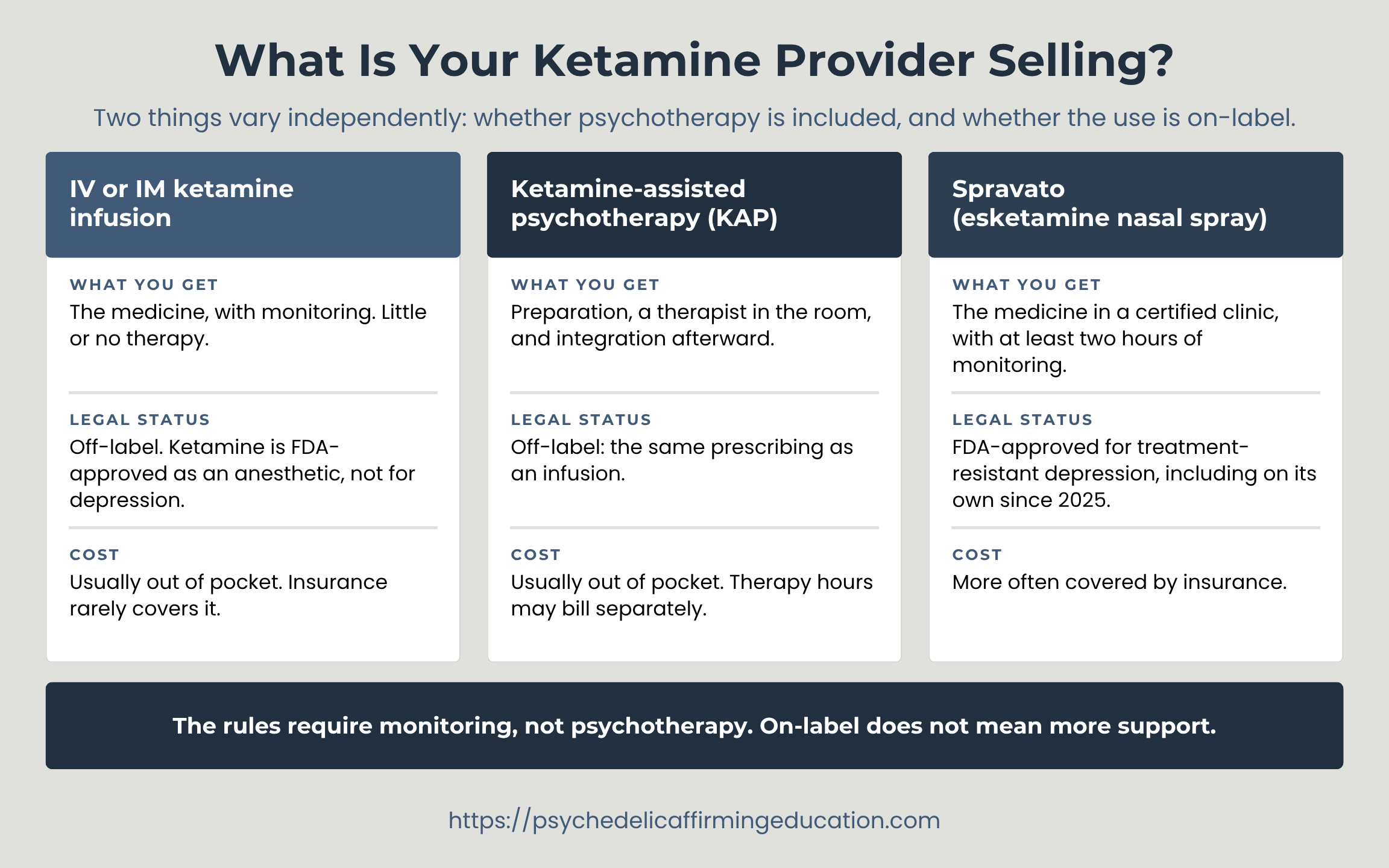
The word “guided” means different things depending on the legal route you are taking, so it pays to understand exactly what you are purchasing. Ketamine is the clearest example, because two distinctions routinely get blurred.
The first is between ketamine on its own and ketamine-assisted psychotherapy. A bare infusion delivers the medicine and little else. Ketamine-assisted psychotherapy, commonly abbreviated KAP, pairs the medicine with genuine preparation, a therapist present in the room, and integration support afterward. These are materially different products, frequently marketed as though they were interchangeable.
The second distinction is between on-label and off-label use. One formulation, an esketamine nasal spray sold as Spravato, is FDA-approved for treatment-resistant depression and may only be administered in a certified clinical setting. Ordinary ketamine, delivered intravenously or by injection for mental health indications, is legal and widely used but not FDA-approved for those purposes; that is what “off-label” means. Off-label prescribing is routine and entirely lawful. It simply warrants more questions.
Regardless of the route, the same five questions apply to any provider: How is screening conducted? What does preparation involve? Who will be present in the room? What support is available after the session? What does the entire course of care cost? Use these questions before you decide.